
Someone, somewhere, might have told you that choosing a preschool is simple. Okay. They couldn’t be more wrong. Deciding on a preschool program—be it Montessori or traditional education—can feel overwhelming. Why is that? Because as a parent, you’re tasked with making a decision that will form the basis of your child’s future education and shape their overall development. It’s important to understand these educational approaches. This article provides a structured comparison that will help you make informed decisions about curriculum development, classroom design, and teaching practices in Montessori vs traditional education.
Foundational Philosophies of Montessori and Traditional Education
When comparing Montessori vs. Traditional Education, a core distinction lies in their foundational approaches. Montessori education operates through self-directed learning and independent exploration, encouraging young learners to follow their curiosity at individual paces. For example, children select hands-on tasks like sorting shapes or practicing coordination through everyday activities, building focus organically. Conversely, Traditional education centers around a teacher-led classroom where lessons follow structured curricula designed for group progression. Instructors guide all learners through uniform objectives, like identifying letters through repeated instruction.
The differences extend to play’s role in learning. In Montessori, play serves as the vehicle for discovery, giving preschoolers freedom to engage with tactile materials that teach concepts like geometry through pattern blocks. Guides observe but refrain from directing this child-led learning. Meanwhile, traditional programs incorporate play but anchor it to academics – imagine counting games used to reinforce math skills during designated “play time.” Teachers design these activities to meet pre-set educational benchmarks while still allowing brief moments of creativity.
Why do these distinctions matter? Parents prioritizing intrinsic motivation and personalized growth often gravitate toward Montessori education, while those valuing standardized skill mastery may prefer traditional systems. Understanding these philosophies ensures alignment with your family’s values – and sets the stage for evaluating practical elements like classroom structures next.
Montessori vs. Traditional Education: Classroom Environments and Learning Materials
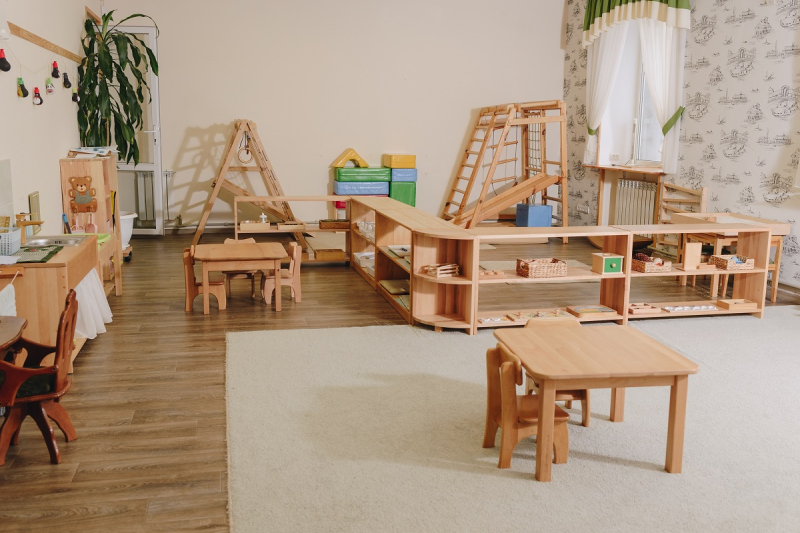
In examining Montessori vs Traditional Education, mixed-age groupings form the foundation of classroom structure, with hands-on materials openly accessible on child-sized shelving. These prepared environments feature wooden blocks and bead counters designed to enable self-correcting exploration, creating a space where preschoolers select activities matching their developmental needs. You’ll notice no plastic toys here; instead, materials prioritize natural elements that evolve with children’s growing abilities through repeated use.
Let’s contrast this with Traditional Education classrooms. Age-specific grades dominate these teacher-centric spaces where rows of desks face boards. Textbooks, worksheets, and digital tools drive learning, with educators controlling access to resources during structured lessons. While these environments include closed-ended materials like alphabet flashcards or counting games using plastic toys, opportunities for spontaneous discovery remain limited.
Montessori design features:
- Low open shelving for independent material access
- Furniture scaled to preschooler proportions
- Peer learning between different age groups
Traditional design focus:
- Standardized seating arrangements
- Centralized teacher demonstration areas
- Age-segregated academic benchmarks
The Montessori classroom’s purposeful layout supports autonomous skill development through tactile engagement with natural materials. Traditional setups emphasize group cohesion through uniform instruction. This environmental contrast directly shapes whether learners follow teacher-led curricula or chart self-discovery paths, a key understanding for parents evaluating learning philosophies. These spatial philosophies set the stage for examining how educators interact within these systems.

Teacher’s Role: Montessori and Traditional Settings
When evaluating Montessori vs. Traditional Education, the educator’s role shifts dramatically between these approaches—student agency versus content delivery. While Montessori teachers serve as observational guides, their traditional counterparts act as centralized instructors driving standardized lessons.
Imagine a classroom where educators prioritize preparation over control. Montessori teachers design environments rich in tactile materials, then step back as children explore. For instance, a teacher might demonstrate leaf identification using a botanical puzzle, then allow preschoolers to independently match specimens. This minimal intervention encourages problem-solving through experimentation, with assessment rooted in observing a child’s progress toward self-set goals.
Teachers in traditional settings, on the other hand, follow structured plans centered on lectures and group instruction. Picture an educator guiding all students simultaneously through letter-recognition drills, correcting errors immediately. Assessments here involve quizzes to benchmark mastery, ensuring alignment with age-specific benchmarks. Homework reinforces concepts through repetitive practice—a sharp contrast to Montessori’s open-ended tasks.
Montessori Role Highlights:
- Facilitates peer mentoring via mixed-age groups
- Prioritizes observation over direct grading
- Adjusts environments to enable differentiated instruction
Traditional Role Features:
- Leads uniform lessons for entire classes
- Uses testing to standardize progress tracking
- Delivers content through scripted demonstrations
The divide in educator approaches shapes whether learning flows from student-led discovery or teacher-guided repetition.Teachers adapting from traditional systems must cultivate restraint—a stark shift from directing activities to nurturing organic skill-building. This foundational difference naturally leads us to explore how curriculum design diverges between these philosophies.
Read More : Understanding the Benefits of Play-Based Learning
Curriculum in Montessori vs. Traditional Education
When comparing Montessori vs. Traditional Education, curricular structures reveal stark contrasts. The Montessori curriculum combinesPractical Life, Sensorial, Mathematics, Language, and Culture studies into hands-on activities – think bead counting for early numeracy or pouring water to refine motor skills. This integrated curriculum lets students revisit tasks like object sorting at their own pace, blending real-world skills seamlessly. For example, preschoolers develop coordination through food prep exercises while naturally absorbing math concepts via tactile materials.
In traditional systems, learning unfolds through separate subjects taught at fixed times. Lessons follow grade-level frameworks: math at 10 AM, reading at 11 AM – each segment tied to age-specific benchmarks. Assessments prioritize quizzes and standardized tests to track mastery.
The divergence matters because Montessori education’s holistic approach bridges classroom concepts with daily life, nurturing interdisciplinary thinking. Practical Life activities – like grace/courtesy lessons – subtly build social-emotional skills alongside academic growth. Meanwhile, traditional models focus on compartmentalized knowledge acquisition within rigid timelines. Educators transitioning between these systems must overhaul lesson plans to align philosophies[. Understanding your child’s needs becomes paramount when weighing subject-specific versus integrated learning paths.
Choosing the Right Preschool Approach
Parents often wonder: How can both Montessori and traditional education foster development? The reality shows these programs each bring benefits to self-directed learners and structured classrooms alike. While Montessori nurtures independence through tactile exploration (“help me do it myself”), traditional systems build group skills through teacher-guided lessons, but neither path guarantees superiority.
If your child thrives in making choices among pattern blocks, you might lean toward Montessori. If regimented reading circles fit better, traditional schooling calls. Both succeed when educators implement methods thoughtfully…and fail when forced mismatch occurs. According to developmental studies, 90% of preschoolers thrive in learning style-matching environments.